Shields
Shields are optional assets that allow you to block incoming attacks.
Blocking, Parrying and Breaking
Because there is no standard nomenclature throughout all games we decided to pick the following terms. However, you can choose to name them in your game as you see fit:
- Block: Stop any incoming attack while shielding that isn't a Parry.
- Parry: Stop an attack where the time window between raising the shield and blocking is shorter than a certain amount. Some games call this Deflect or Perfect Blocking.
- Break: Whenever the defense position of a character is broken, due to receiving too many impacts.
The Shield Asset
To create a new Shield asset, right click on the Project Panel and select Create → Game Creator → Melee → Shield.
Defense
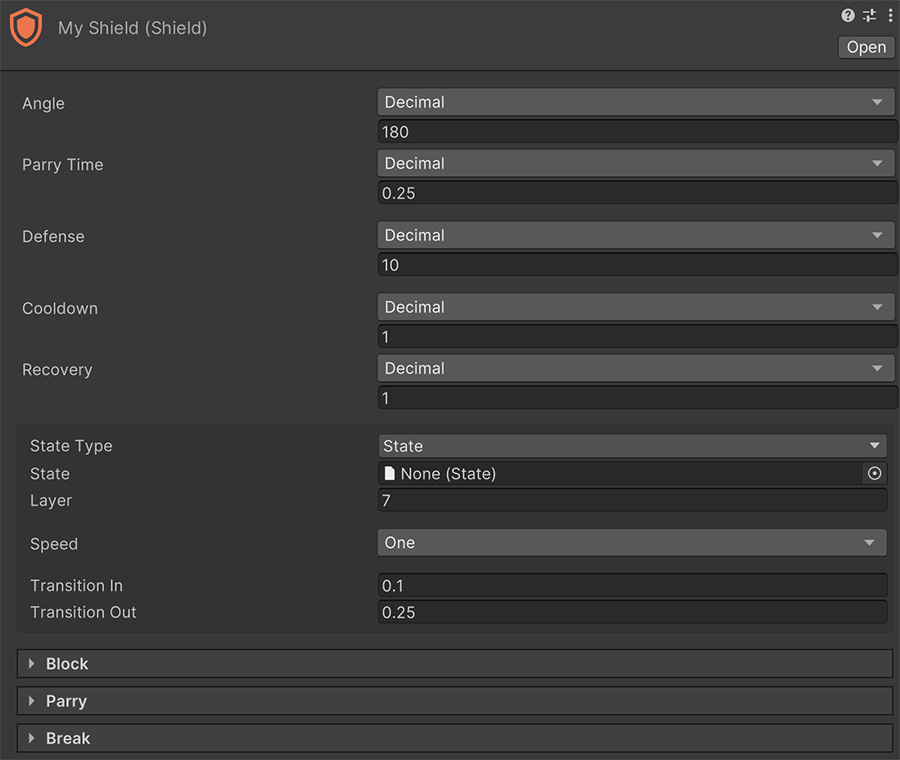
The uppermost values determine how the weapon can defend from incoming attacks.
The Priority field is used when a character has more than one Weapon equipped and several of them have a Shield. In that case, the Shield with the highest priority value is the one used to block attacks. By default it has a value of 1.
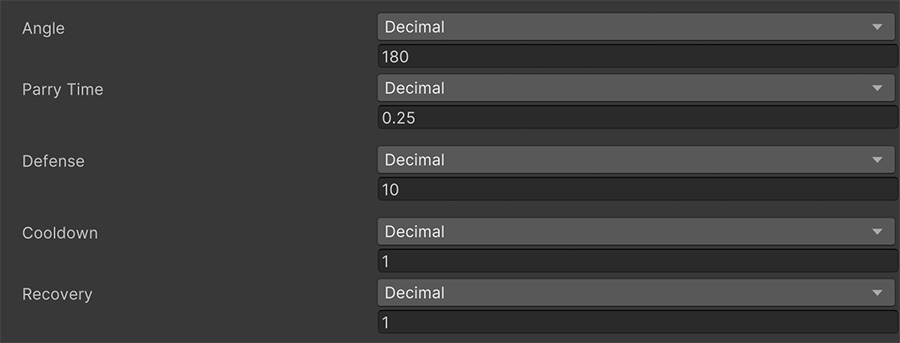
The Angle field determines how aligned the character must be towards the attack in order to block it, starting from the front. The angle is split evenly between both sides, so a value of 180 degrees defends from any attack that comes from the front half of the character (up to 90 degrees towards each side). A value of 360 will block any attacks from any direction. By default it is set to 180 degrees.
The Parry Time field determines the maximum time window, in seconds, between when the block starts and when an attack connects to be considered a Parry. If the time between raising the shield and blocking the attack is higher than this value, it will be considered a normal Block. By default it is set to 0.25 seconds.
The Defense value is a number that decreases with each blocked attack. If the value reaches zero, the defense will be broken and any other attack will hit the Character. By default it has a value of 10.
Defense and Power
Each blocked attack subtracts the Power of the attacker's Skill from the Defense value. For example, a Shield with a Defense of 10 can block two attacks with a Power of 4 in quick succession, but the third one will break the defense. Note that a Parry doesn't subtract any value from the Defense.
Visualizing the Defense value
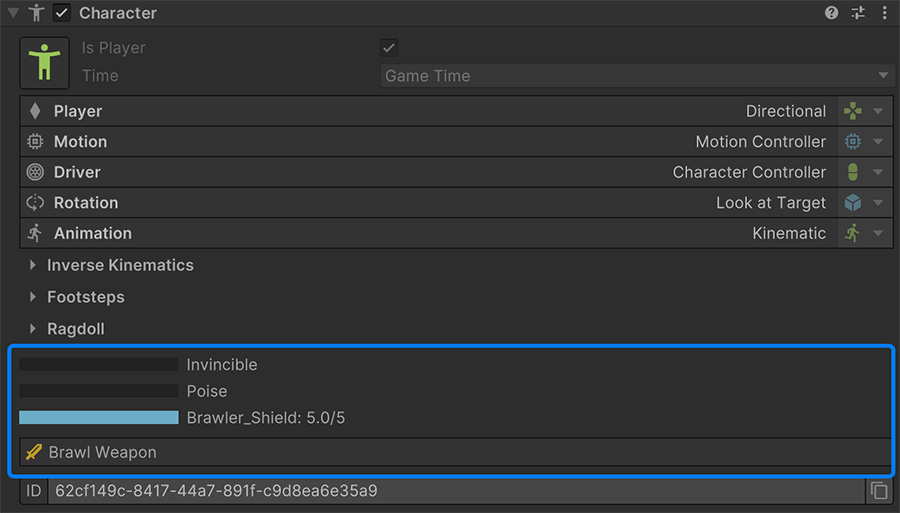
To visualize the current Defense of a character, enter Play Mode and select the character. Once a weapon is equipped, a few new fields will appear at the end showcasing the currently equipped weapons and combat values.
The Cooldown determines how long it takes to start recovering Defense after decreasing it from a blocked attack. By default it is set to 1 second.
The Recovery field determines the pace at which Defense is recovered, in units per second. For example, a value of 2 means it will recover 2 units per second. By default it is set to 1.
States
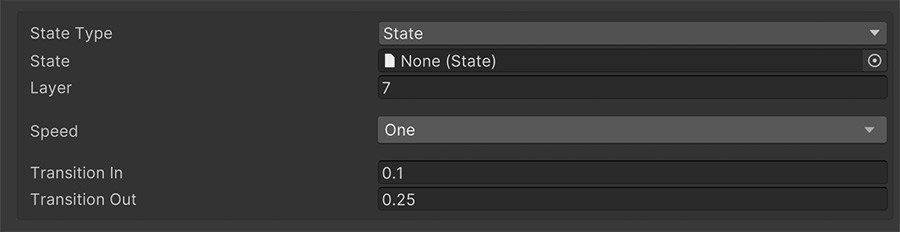
A Shield allows you to change the animation State of the character when raising the shield and stop it automatically when lowering the defense.
State Layer
It's very important to be conscious of the Layer field! By default, Weapons use the layer index 5. Shields use the layer index 7, which is two units higher than the Weapon layer index so that the blocking state overrides the weapon one during that state. Layer 6, by default, is reserved for Charged Skills.
The Speed field allows you to run the whole State animation faster or slower using a coefficient. A value of 1 means the animation will run normally and a value of 0.5 means the animation will be in slow motion.
The Transition In and Transition Out fields determine the time in seconds it takes to blend into and out of the state. We recommend using small values, between 0.1 and 0.5 seconds.
Blocking
Blocking happens whenever the character blocks an incoming attack that isn't perfectly blocked (also known as parried).
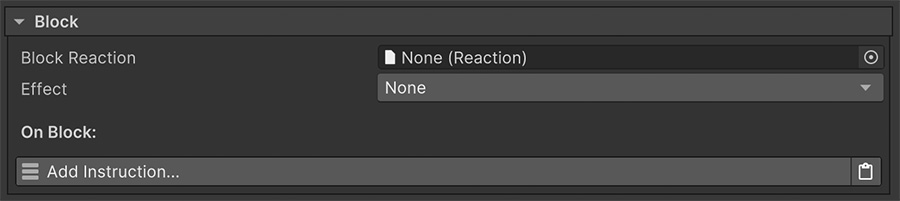
The Block Reaction field allows you to play an animation gesture when blocking an attack. See Reactions for more information.
The Block Effect field allows you to instantiate a prefab at the point of impact. For example, a particle effect that highlights the blocking.
The On Block instructions are executed every time an attack is blocked, regardless of the type of attack. When these instructions are executed, Self refers to the character blocking the attack, and Target to the attacker.
Parrying
Parrying happens whenever the character blocks an incoming attack and the time between raising the shield and the impact is less than a certain amount of time. This mechanic is also commonly known as perfect blocking.
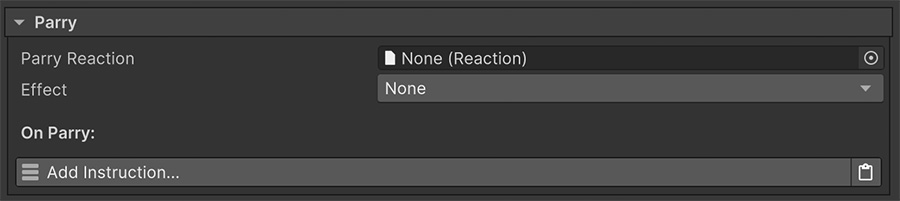
The Parry Reaction field allows you to play an animation gesture when parrying an attack. See Reactions for more information.
The Parry Effect field allows you to instantiate a prefab at the point of impact. For example, a particle effect that highlights the parry.
The On Parry instructions are executed every time an attack is parried, regardless of the type of attack. When these instructions are executed, Self refers to the character blocking the attack, and Target to the attacker.
Breaking
Breaking happens whenever the character's blocking defense is broken. When a character starts blocking, it has a defense gauge that decreases with every attack blocked. If the gauge value reaches zero, the defense becomes broken, the character lowers the shield and is open to attacks.
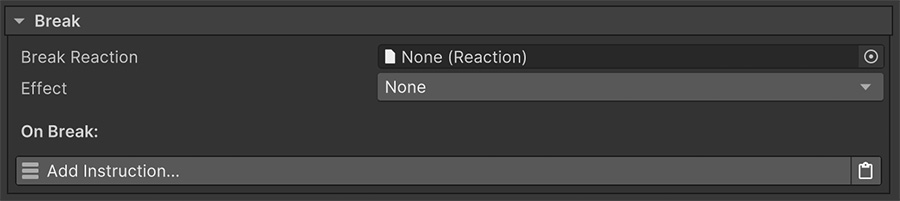
The Break Reaction field allows you to play an animation gesture when the defense is broken. See Reactions for more information.
The Break Effect field allows you to instantiate a prefab at the point of impact. For example, a particle effect that highlights the point where the defense is broken.
The On Break instructions are executed every time the defense is broken, regardless of the type of attack. When these instructions are executed, Self refers to the character blocking the attack, and Target to the attacker.